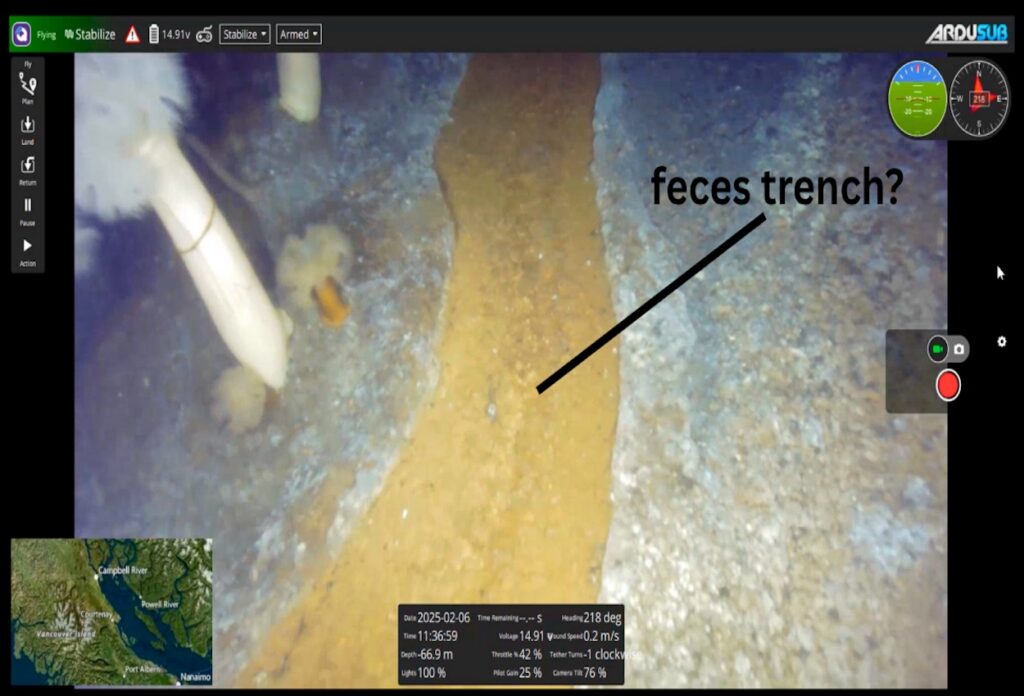
Some losses are impossible to ignore. During a recent Clayoquot Salmon Investigation (CSI) trip, we found a Marbled Murrelet swimming in a Cermaq salmon farm near Tofino. According to Cermaq’s public records, 5 Murrelets died in 2 different farms in 2025.
Why are we alarmed? These are no ordinary seabirds; Murrelets are an old growth-dependent species, which forages in the ocean and lays a single egg on a mossy branch of an ancient tree. The marbled murrelet is red-listed as globally endangered by the International Union for Conservation of Nature, who lists their population as declining.
A Bird Between Forest and Ocean
The Marbled Murrelet (Brachyramphus marmoratus) is a small, secretive seabird of the North Pacific, about the size of a sparrow. Unlike most seabirds that nest in colonies on cliffs or islands, murrelets nest alone in old-growth forests, often far inland, on broad, moss-covered branches. Each bird lays just one egg per year in a shallow depression on a branch.

Parents travel incredible distances, up to 100 km a day, between their forest nests and coastal waters, hunting small fish to feed their chick. They fly silently at dusk and dawn, reaching speeds over 80 km/h to avoid predators. Their secretive lifestyle, slow reproduction, and dependence on both old-growth forests and healthy oceans make them highly vulnerable. Their life illustrates a deep truth taught by the Nuu-chah-nulth First Nations: His-shuk-nish-tsa-waak, (we are all one and connected). Forests, oceans, and the species that move between them are part of one living system.

What’s at Stake
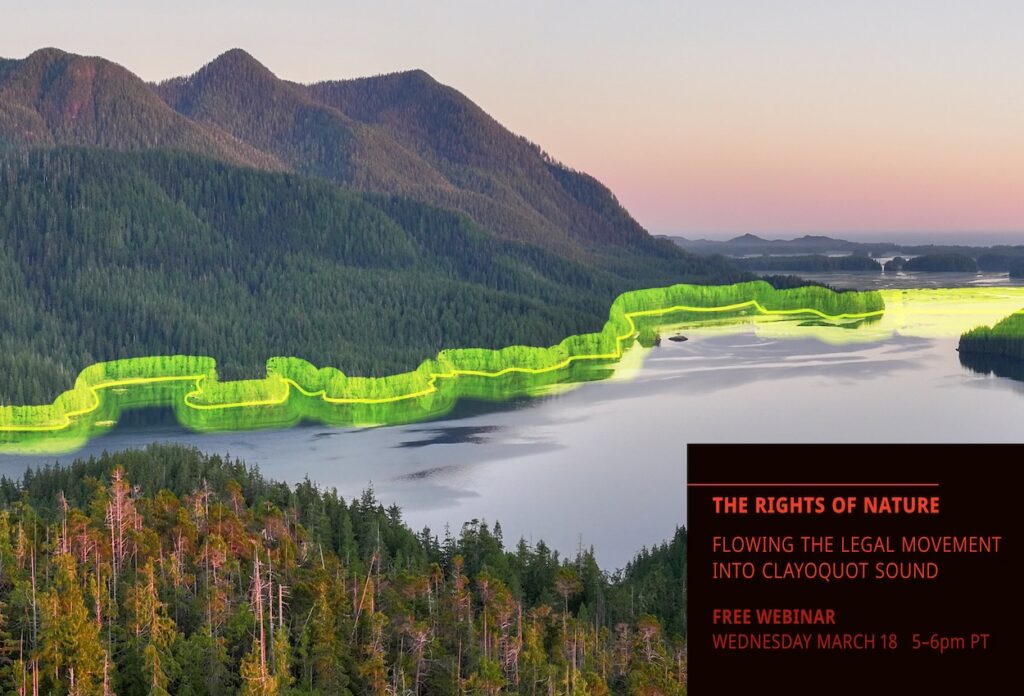
The valleys and fjords of Clayoquot Sound comprise Vancouver Island’s largest intact ancient rainforest, and should provide a haven for Marbled Murrelets. During our regular fish farm monitoring, we often see Marble Murrelets feeding close to the farms. Rich fish feed attracts small fish that murrelets prey on, such as Pacific Herring and Northern Anchovy. These small fish often live their lives inside the fish pen—once trapped inside many die.

Cermaq’s wildlife mortality reporting claims to be current, yet the most recent incident listed dates back to February 2025. In that report, four Marbled Murrelets died after becoming entangled at the McIntyre Lake farm, with another reported dead at the Millar Channel site. Our own observations in January 2026 of a Marbled Murrelet trapped inside Cermaq’s Rant Point fish farm show—sadly and clearly—that operations continue to harm these threatened seabirds.
Every Marbled Murrelet lost represents far more than a single life; it is a breeding adult that may never return, a chick that may never hatch, and another blow to a population already under intense pressure from habitat loss. It highlights the troubling gap between legal protections on paper and what is actually happening on the water.

Responsibility
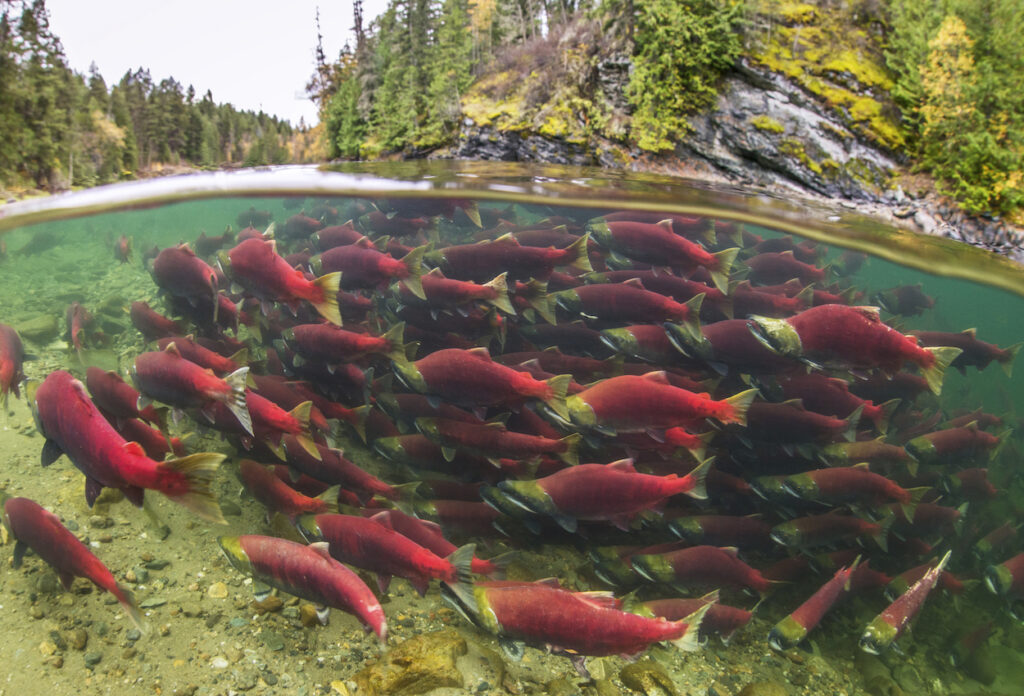
Much of Clayoquot Sound’s ancient forest, the ancestral gardens of the Nuu-chah-nulth, has been protected from industrial logging. But forests cannot survive alone. Wild migratory salmon carry nutrients from the ocean to the forest, feeding everything from bears, to the soil that feeds the trees which carry Murrelet nests. Protecting the old growth in Clayoquot Sound was essential. Protecting migratory salmon must be next. For all that depends on them, and for future generations.
Stewardship must honour the full connection: forest, ocean, and wildlife alike. These rare seabirds should not be dying in industrial nets, especially not in a Biosphere Reserve. Removing salmon farms from the ocean not only protects migratory salmon, but also safeguards marine life. Protecting these connections isn’t optional—it is a responsibility.
Dan Lewis is Executive Director of Clayoquot Action.