The news cycle is so relentless these days—but every now and then, good news comes through!
Such was the case this January, when CBC reported that the Discovery Islands appeal had been lost—by fish farming giant Mowi. This case has been dragging on since 2020, when Minister of Fisheries Bernadette Jordan announced a phase-out of open-net pens in the Discovery Islands. Those farms were never re-stocked…
Removing fish farms works!
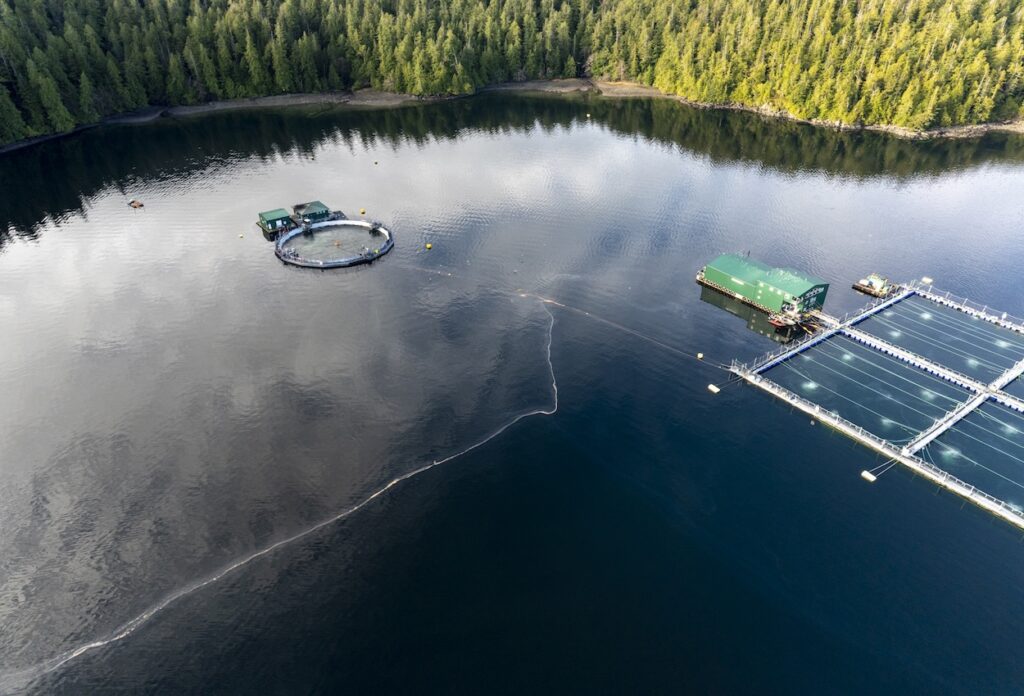
The Discovery Islands are a maze of islands between Campbell River and the mainland coast. They create a series of narrow corridors which millions of Fraser River salmon use when migrating north in the spring. Studies showed that wild salmon were clean heading up the Salish Sea, but were covered in salmon lice by the time they got past the Discovery Islands fish farms.
Once those fish farms were removed from the ocean, migratory salmon numbers began to climb! This removal, in combination with the phase-out of most of the Broughton Area farms, has triggered a huge comeback of salmon. Government claims they don’t know why, and some scientists say it’s too early to say the removal caused the rebound. But it’s getting harder every year to deny the truth—removing fish farms works!
Precautionary principle upheld
The Norwegian companies who own the BC industry sued the Canadian government, not once, but several times. Each time they lost, but won on appeal. By the final round, it was only Mowi suing Canada. Their loss was decisive. The only way forward now would be for Mowi to take their appeal to the Supreme Court of Canada.
The Federal Court of Appeal has upheld the Minister’s right to use the precautionary principle when making decisions. This principle says that if the consequences of conclusively proving harm (say, from fish farms) are too high (say, extinction), then we need to be cautious moving forward. There is a large body of evidence of harm from salmon farms, and the Court noted the dire consequences that declining wild salmon stocks could have for First Nations rights, the economy, and the social fabric of British Columbia.
Industry on notice
Let’s give the last word to our friend and ally, independent scientist Alexandra Morton, who writes: “The Discovery Islands win provides certainty to the salmon farming industry, that the coming 2029 ban on marine salmon farms is on solid legal ground. The industry is now on notice to avoid sinking costs into breeding farmed salmon cohorts that won’t mature by June 30, 2029.
Congratulations to Ecojustice, and our colleagues at Watershed Watch Salmon Society, Living Oceans Society, David Suzuki Foundation, Georgia Strait Alliance, and independent biologist Alexandra Morton for seeing this win through!
Dan Lewis is Executive Director of Clayoquot Action.