On November 25, 2024, we exposed yet another failure of Cermaq’s semi-closed containment system (SCCS). When we approached the farm, the stench of rotting fish was the first sign that something was wrong. Then we saw it: a visible sheen of fish oil, and fragments of decomposing tissue, both inside and outside the pen.
Internal documents obtained through an Access To Information (ATIP) request later confirmed our concerns—something was going seriously wrong at Cermaq’s experimental facility.
But nothing prepared us for what was revealed in footage released after government officials inspected Cermaq’s SCCS.
Dubbed ‘the Sh*t Tapes’—because there was no point in softening the truth. The sheer volume of feces and waste feed being discharged into coastal waters by a relatively small experimental salmon farm was staggering. What we witnessed was foul, disturbing, and impossible to ignore.
Equally troubling are documents showing redacted information about fish health issues within the SCCS facility near Tofino, and the use of the antibiotic Florfenicol on seven separate occasions, from October 2024 to February 2025 (see full ATIP).
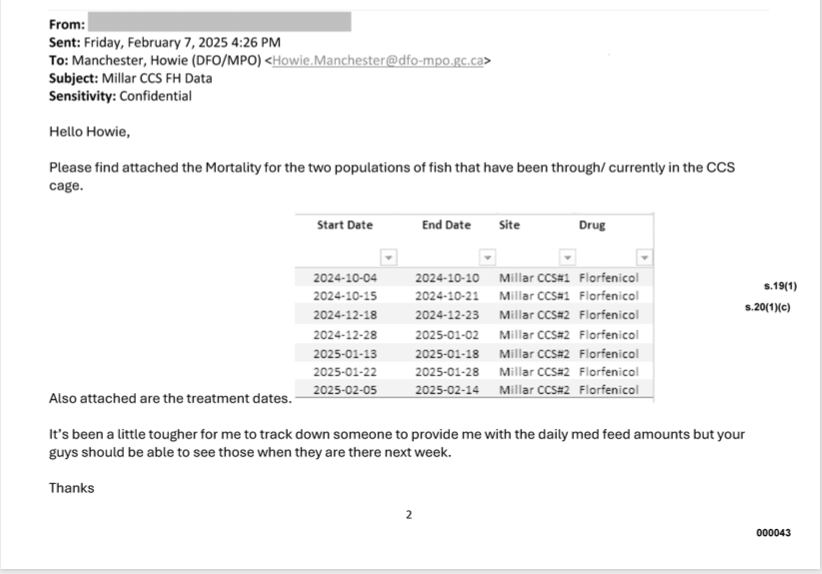
Florfenicol is an antibiotic commonly used to treat (highly contagious) furunculosis in farmed salmon. It is typically administered through feed. As DFO’s video evidence shows, uneaten feed spreads well beyond the pens and settles on the seafloor. It is therefore entirely plausible that medicated feed would have been consumed by wild species such as fish, crab, or prawns.
This raises serious concerns—not only for marine life, but for human health as well. What happens when people harvest seafood in areas where medicated feed has been discharged? To our knowledge, no public notice was issued to warn local communities or fishers of this potential risk.
Florfenicol: Alarm Bells in Tasmania
Florfenicol has recently made international headlines. In late 2025, Australia granted emergency approval for its use following a massive Piscirickettsia salmonis outbreak that killed millions of farmed salmon in Tasmania.
According to media reports and Right to Information summaries of EPA data, salmon companies used approximately 700 kilograms of Florfenicol in just 13 days in the D’Entrecasteaux Channel—more than 10% of all Florfenicol used by the industry over the previous six years. (Thanks to the Bob Brown Foundation for bringing this information to public attention.)
Questions Remain
Why was there no public notice when Cermaq used the antibiotic Florfenicol in Clayoquot Sound? Why were local communities, fishers, and seafood harvesters kept in the dark? Why are facts that directly affect public health, wild species, and a globally significant ecosystem being withheld?
The public deserves transparency. Coastal waters deserve better.
Dan Lewis is Executive Director of Clayoquot Action.