On the weekend of 1-2 November 2025, hundreds of First Nations leaders, members and allies gathered in Port Alberni BC for the Migratory Salmon Potlatch. The gathering was hosted in Hupač̓asatḥ and C̓išaaʔatḥ territories by Hupač̓asatḥ Ḥawił Tsu Tsii In (Alton Watts) and Ḥiškʷiiʔatḥ Elder/Artist Aniičačist (Tim Paul). The purpose was to practice the Potlatch system as a cultural framework to deal with the complex topic of getting fish farms out of coastal waters.
Invitation parties went out all summer to hereditary chiefs, matriarchs, fisher families, youth, Indigenous knowledge holders and culture keepers as well as allies, scientists, and all friends of migratory salmon. The Potlatch featured many speakers sharing stories about stewardship, traditional leadership roles and responsibilities.
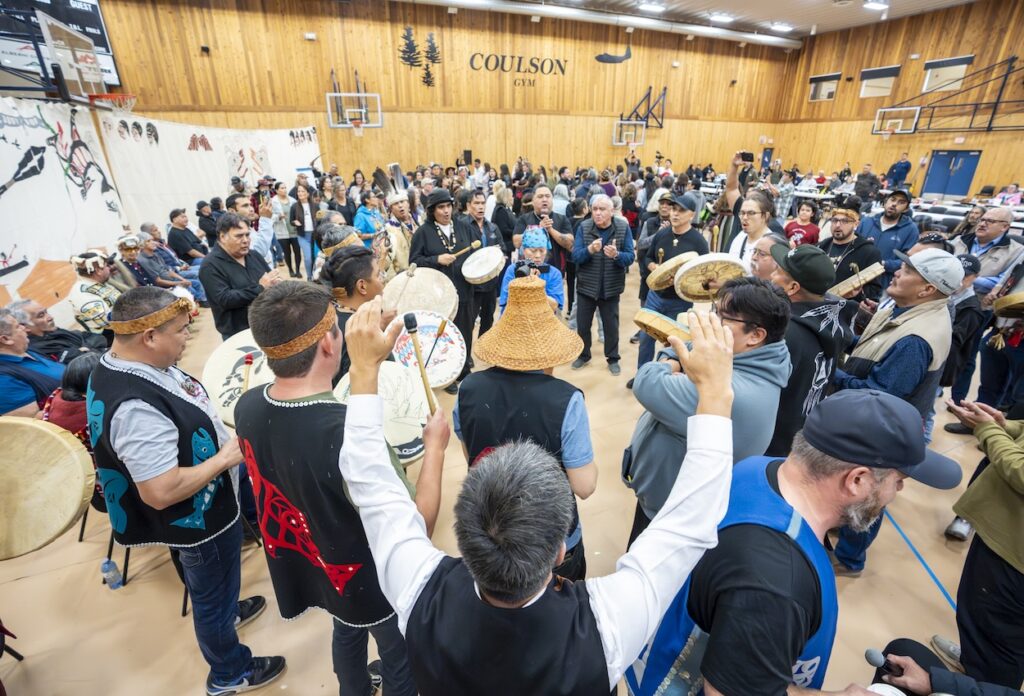
Many spoke of the challenge of living in 2 worlds. The Potlatch was chosen as a cultural way to address the wicked problem of salmon farming, which sees traditional families, communities and Nations being divided by transnational corporations. Host Alton Watts wanted to bring everyone together in a good way, to share meals, to enjoy the scarce seafood resources (whose future is still threatened), and to share cultural teachings, songs and dances to build good energy for migratory salmon.
And many First Nations showed up! Leaders gathered from far and wide, including members of the Winnemem Wintu Tribe from California (who removed dams on the Klamath River to bring back their salmon), the Syilx Nation and the Tsilhqot’in from the Interior, as well as Nations from all over Vancouver Island.
The Kwakwaka̱’wa̱kw Nations of the Broughton Area made a thunderous entrance, with over one hundred people drumming and singing their way in. The hall reverberated, and they brought the house down with a message of hope, saying ‘We removed salmon farms from our waters, and are being richly rewarded with an abundance of salmon returning to their parent streams. You can do it too, and we’re here to show our support!’.

Nations without salmon farms, such as Hesquiaht here in Clayoquot Sound, made strong statements about the declines they see in their territorial wealth, and the importance of standing together to protect what’s left. Tla-o-qui-aht showed up, singing and dancing for an hour, taking us into the wee hours of Sunday morning.

Citizens & leaders from Ahousaht pleaded for help, saying their leadership wants to keep fish farms in the water past the 2029 deadline imposed by the federal government. The point was emphasized, that not all Ahousaht people agree with MHSS (Ahousaht economic development) on this file.

On Sunday morning, a Migratory Salmon Declaration was signed by Chiefs from many Nations. The declaration calls for signatories to “Relentlessly work towards the immediate removal of all open-net pen fish farms, which is within our control and works to help Salmon return in abundance”.

Many referred to the potlatch as ‘historic’, and it may well be a turning point.
The impacts of salmon farming do not recognize borders, and cannot be contained in any one Nation’s waters. As well, salmon swim into the waters of other Nations, where they cannot be protected from fish farms. Salmon also swim from territory to territory, spreading pathogens from fish farms as they go. The Declaration ‘acknowledges that no one has a right to condemn a species to extinction’. It’s time to work together, to create abundance not just for humans, but for all of Nature.

With Washington State having banned open-net pens, BC is the only jurisdiction allowing them on the west coast of North America. In BC, over 120 First Nations want fish farms out, as do 75% of citizens. The fact that the feds plan to ban salmon farms is a good first step. Everyone has already done so much to get fish farms out. Now, it’s up to us all to create the pressure needed to put this issue over the finish line!
Read the Declaration HERE
Dan Lewis is Executive Director of Clayoquot Action.